Showing posts with label Blaenau Ffestiniog. Show all posts

Sunday, 20 October 2013

All change at Blaenau

Ffestiniog is not the end of the line but where it all began, with slate heaved out of mountains onto wagons for a thirteen mile descent by gravity to ships at sea. It’s also the top of the Conwy Valley line from Llandudno. A railway mecca; relics of tracks on, down and inside the rock with slate the Victorians reason for it all.

Chisels in the sun
The industry is about 1% of what it used to be and the steam trains are busy with passengers not freight. Stepping off the train your eyes are drawn through twin pillars towards the rocky horizons that frame the town. Each pillar made with 9,000 stacked slates from Llechwedd quarry, a CROESO welcome and directions indicated by the motif of a slate splitter’s chisel. Steps to the street are framed by four huge chisel-shape sculptures with slates stacked at an angle; not any old angle but 30°, the typical lie of a bed of Blaenau slate. 

Bands of single line poetry encircle the pillars and also dissect the town’s pavements. Some, such as ‘a bracelet of a town on the bone of the rock’, by famous poets and others by local schoolchildren.   All carved in Welsh with translations provided online and in booklets. Reading these and their explanations brings a deep insight to the community past and present. Even the bus shelters are a revelation with ‘fat ladies’ on the floors! Most sizes of slate were named after aristocratic women such as ‘duchess’, ‘marchioness’, ‘narrow lady’ and so on. Replicas with their names and dimensions are embedded in the ground. 

Howard working on the river of slate
Across the street is another set of twin pillars with a small quarry train pulling slate wagons down from the marshalling yard. But before you reach this, stop and admire the river of slate, a pavement mosaic with a river running down the middle. On either side are the names of over 350 quarries from across Wales each carved into a block of slate that matches the colour from that particular quarry. A rich mix of greys, reds, purples and greens set in alphabetic order. 

Local artist Howard Bowcott, creator of the works, described the significance of the river: ‘it symbolises the formation of slate with river mud washed out to sea four or five hundred million years ago. The river was also the vital corridor for exporting slate before the Ffestiniog Railway opened in 1836.’

Each bank of the river has a line of poetry by Gwyn Thomas, one in Welsh and one in English. ‘Time flows on and water too but not the life of a rockman’ and ‘Men die. The rocks and empty darkness of these mountains endure’. Worked out slate chambers are the ‘empty darkness’ and both poems reflect the perilous work conditions of the ‘rockmen’ and their transience, but a blink compared to the life of rock.

A version of the
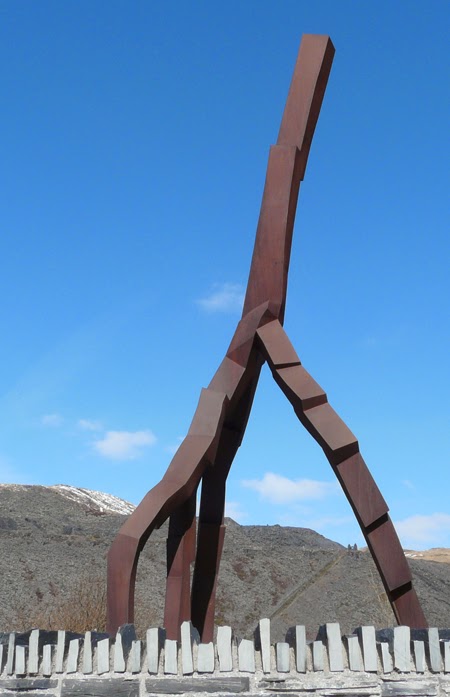
Lightning Strike by David Nash
London has the Shard and the Gherkin but we’ve got our Chisels and the Lightning Strike. This sculpture by David Nash reflects the zig-zag shape of the quarryman’s path descending the slate spoil from the Oakeley quarry. It now stands on the main road midway between the quarry and the centre of town – the only Nash work of art on permanent display in Wales.  

If words and symbols of Blaenau’s slate heritage are not enough, keep on walking about ten minutes out of town to Llechwedd Slate Caverns where you can literally get beneath the surface of it all. They offer a choice of two underground tours and provide exhibits that bring to life the incredible stories of rock cannons and wild cars. This is also the place for downhill biking; a bit like skiing, the riders buy a ‘lift pass’ for the day hurtling down a choice of runs ranging from the gentle blue to the double black. It makes a good spectator sport.

Everywhere is unique but Blaenau takes the biscuit! Local artist Falcon Hildred says in his recent book ’I believe that Blaenau Ffestiniog and its landscape are the best and most complete surviving industrial landscape in Britain’.  It’s not stuffed away in museums but all around you. Shops are one-offs where you buy bread from a baker, local meat from a butcher and discuss the finer points of DIY with the ironmonger. Cafés are homely and good value.

No amount of words can describe this place, it must be experienced. If you’ve been before, you won’t recognise it.


Wednesday, 10 April 2013

From the Rock ... of Blaenau Ffestiniog

The streets of Blaenau are paved with slate, at least slate bands of poetry. There’s the River of Slate, a pavement mosaic with a river running through and on either bank the names of the 350 slate mines of Wales, each engraved on a block of slate the colour of that quarry. And then there are the massive slate sculptures, the 7.5 metre tall chisels, each made up of 15,000 stacked slates. They’re at a 30° angle, the lie of the Blaenau seams of slate. There is more to this town than meets the eye and recent developments cause people to stop in their tracks and wonder why?

The town is home to many relics of its industrial past and Falcon Hildred’s recent illustrated book is a great way of seeing what’s on offer. Another great way of discovery is to join the Snowdonia Society’s guided walk on Saturday 4th May led by Kevin Hall.  


The morning walk begins at 10:30 and is described as easy, about 1.5 miles mostly on pavements, to see the architecture and culture of the town, including the new O’r Graig ('From the Rock') structures and inscriptions. There will be a break for lunch, either a picnic or at a café or pub in town. In the afternoon at about 13:00 there will be a moderately strenuous walk to Pant yr Ynn, the mill where Falcon Hildred will show us his fascinating building with his collection of paintings and artefacts. If enough water is flowing the millwheel will be turning.

Later that afternoon there will be a walk of about 4 miles on more difficult terrain with some steep ground and rough terrain returning to the centre of town (by about 16:30) along footpaths via Cwm Bowydd.

The walk is open to anyone with a suggested minimum donation of £3 for members of the Snowdonia Society and £5 for non-members. Please bring a drink, a raincoat and wear appropriate clothing & sturdy footwear. All children should be accompanied by an adult.

If you would like to book onto the event please contact  info@snowdonia-society.co.uk

For those who can't make a 10:30 start there will be an alternative shorter walk led by Huw Jenkins starting at 1pm. The meeting point is underneath the canopy next to the 4 giant chisel-shaped sculptures. No need to book and donations to the Snowdonia Society will be welcome. There will be lots going on in Blaenau this weekend which is the celebration of 150 years of steam.


Wednesday, 31 October 2012

River of Slate


Howard Bowcott invited me to his workshop to see the final touches to the giant jigsaw, the River of Slate. River  - because that’s how all the sediment gets washed down to create the mudstone which morphs into slate. River - because the Dwyryd was where the slate used to be boated out to the waiting ships.

This stunning work will soon be in the centre of town for people to walk on. What sacrilege! I hope they take off their shoes.

Here’s Howard busy with the slate:


Wednesday, 15 August 2012

Fat Ladies in Blaenau bus shelter


Scaffolding down and the sculptures are looking great with the steps ready to go in. Completion date only about a month away. Here’s Howard Bowcott talking about the project and some of the fine detail regarding ‘fat ladies’ in the bus shelter:


Previous films about the progress of the sculptures can be seen through these links:


Wednesday, 11 July 2012

Our Angel of the North?


11th July 2012 and the crane was hoisting the final components on top of the sail shape, slate sculptures. Will this be our ‘Angel of the North’? 

Howard checks the alignment

The project is generating a lot of interest – while I was filming I got talking to a couple on their first visit in thirty years. They could not believe how much things had changed and said they would be back next year to see the sculptures unveiled from their scaffold.
  

Tuesday, 26 June 2012

Changing face of Blaenau Ffestiniog


The big crane was in the station car park today hoisting massive chunks of slate sculpture into position. Using block tackles the first piece was tilted to just the right angle then lowered through the scaffolding, around the concrete reinforcing rods and onto its plinth. Precision work. Larger pieces followed and the work is rising out of the ground. I'll be back in late July to see the final pieces go on top. Below is a film clip of this stage. Earlier stages of the project can be seen in The Workshop and at the Station Entrance.


Friday, 4 May 2012

Maentwrog-on-Sea?


Pont Briwet
It doesn’t sound right but, half way up the Vale of Ffestiniog, we’re on the Wales Coast Path! Further downstream is Pont (bridge) Briwet, but that doesn’t (yet) take walkers. It’s about to be rebuilt and maybe, in a few years time, there will be a footbridge. Another alternative is to wade across to Portmeirion at low tide but make sure you don’t step in the wrong part of the sands.

So, if you’ve made it half way up the Vale of Ffestiniog, why not go the whole hog? We’ve created this little eighteen mile diversion for your delight and delectation. The route takes you up to the ancient village of Llan Ffestiniog, with its community pub, then high up to the quarry which housed the National Gallery in WWII and down the other side of the valley where the last wolf in Wales was slain.

This is the Vale of Ffestiniog Way. You won’t believe how wonderful it is until you try it. 

Tuesday, 27 March 2012

Another turn of the wheel


Melin Pant yr Ynn, the Mill in the Ash Hollow. Clinging to the rocks beneath Blaenau’s slate quarries with a huge water wheel on its side, this mill began its working life in about 1845. Now in the 21st century it retains much of the character and spirit of those Victorian times captured by Falcon Hildred, industrial designer, renovator, artist and resident owner. 

Falcon grew up in war torn Coventry and has abiding memories of the drab, colourless, depressed townscape following the devastating blitz. All investment and manpower was naturally directed to the front line. It was not until 1951, and the Festival of Britain, that Falcon appreciated the full extent of how drab and decrepit everywhere had become, as the nation attempted a revival through the promotion of better quality design in the redevelopment of its towns and cities. Suddenly there was colour, gleaming glass and excitement as the old made way for the new.

But as is the way with big plans, things were not always for the better. Some of the decrepit buildings were priceless gems that should have been restored and the replacements were anything but good design. Using his skill as a designer and artist, and in between his job with a firm of architects, Falcon set about recording these buildings before they disappeared – accurate on-site drawings bringing out the essence of their character, as opposed to a photographic snapshot.

As time went by the new buildings seemed to get worse, the treatment of the past was ever more brutal and thoughtless. The ‘swinging sixties’, great in many ways, but a decade of the swinging demolition ball. Time was running out fast so Falcon switched from part time recording of these treasures to full time, giving up the security of being an employee and making ends meet through freelance assignments.

It was during this time that he came across Blaenau Ffestiniog, such an intriguing name on a map, with contour features and inclines everywhere, that Falcon came here for his holiday. In 1968 he bought Melin Pant yr Ynn and has made this the base for his work ever since.

Most likely the mill (melin) was built about 1844 for the pioneering Diffwys Quarry and by 1846 it had been equipped with the massive wheel and driveshafts to run saw tables and planing machines. Not for the manufacture of slates but massive slabs. A description by a quarryman from 1858 reads: the quarry has “heaps of flags or slabs for sawing purposes, varying in sizes from four to twenty four feet long” …. “without either joint, spar or ribbon in any of them, and perfectly free from sulphur. Such blocks as these make the most splendid and costly tomb stones, chimney pieces &c.” Probably snooker tables too!

For about twenty years these huge slabs were transported down from the quarry for sawing and planing using the power of the mountain stream. Apart from circular saws there was also a ‘sand saw’ and records show frequent deliveries of sand shipped up river ‘18 Jan 1858 Robert Richards boatage of 4 Tons sand for Saw mill - 6 shillings.’ But water gave way to steam and the quarry invested in on-site, steam driven mills, removing the machines closer to the raw material, much more efficient albeit needing fossil fuel. 

In 1866 the mill was used as a cold and draughty school for seven years and around about 1881 was taken over by Jacob and Zadrach Jones as a woollen mill operated in conjunction with the fulling mill (Melin Moelwyn) at Tanygrisiau. Spinning and weaving of the wool was done at Pant yr Ynn before being taken down the road for ‘fulling’ or finishing. And this continued all the way to 1964 when both mills stopped working.

Nowadays Pant yr Ynn is once again in good condition, with a working wheel, waterproof roof and a permanent exhibition of artefacts and drawings celebrating our industrial past. Visitors are welcomed throughout the summer months to walk around, and enjoy Falcon’s industrial art, not in the sterile atmosphere of a gallery, but within the space of a mill that has seen real toil and sweat. Not a Lowry in the Tate but Falcon in Blaenau – the ultimate setting in industrial landscape.

The ground floor is where Falcon does his work and the drawing room is certainly no lounge. The workshop is meticulous and functional. Exhibition areas are well presented, there is a feel of stepping back in time. Upstairs is for living. With an industrial scale dormer window the length of the room and a pot-bellied stove keeping you warm as the light floods in and you soak up the perfectly profiled view of the Moelwyns. Inspiration comes racing over the horizon.

Standing back from the window is the kitchen and dining area, simple, functional and tasteful. Not a pot jammed full of cooking implements but an array of cooking tools as in a well ordered shed. As for the cooker, it’s simplicity and elegance itself, bought second hand forty years ago and going strong ….. there’s not much that could go wrong with it. A perfect industrial design.

I asked Falcon what his favourite memory was and he looked back to his old diary for an autumn day in the millennium year and read out the entry:

Waterfall in full spate.
Mill wheel gently turning.
Smoke rising from the chimney.
The Moelwyns emerging from cloud.
Autumn colours.
Rain-washed landscape
sparkling in the sun
Blaenau and the mill truly at their best

For the moment the mill is where you will find Falcon but his collection of over 600 original drawings and watercolours are being taken into the care of The Royal Commission on the Ancient and Historical Monuments of Wales. The collection has been catalogued, and high-quality digital images will be available online through Coflein (the Royal Commission's online database), and People's Collection Wales websites. Time for another turn of the wheel.

Friday, 17 February 2012

Sculpture and pavement poetry

High rise slate sculptures continue to sprout in the centre of Blaenau. The current spell of misty drizzle presents no problems whilst freezing temperatures a couple of weeks ago were no good for concrete work.

Another set of contractors are laying paving stones with a handy gadget that picks up each slab by suction. Excellent for precision work also kind on backs and fingers.

Every few steps there’s a line of Cymraeg on a slab of slate embedded in the pavement with a number. I think number 32 translates to ‘stone hearth’.

Saturday, 11 February 2012

Blaenau Downhill

There’s been talk about Blaenau’s downhill biking for a few years, with recent progress marked by the uplift road reaching towards the top of the mountain. But for me, on an icy, misty Saturday morning, this was the first time I got really excited.  Simon from Antur Stiniog and Ceri led about 30 of us up the mountain to see the work in progress.

Along the way were trails in varying states of completion and parked, with their buckets planted nose first into the ground, were the orange excavators. One of the drivers is Jason Rennie, famous for achieving the world record jump on a mountain bike of over 134 feet at Llandegla in true Evel Knievel style. Not just a digger driver but a devotee of the sport and this, along with the biking or motocross skills of the other operators, will make Blaenau’s downhill that much better.

Steeply cambered hairpin bends on high cliffs looked inviting, but the more I looked the more I thought this could be a spectator sport. At the very top a small mound marked the site of a ramp from which bikers will launch onto their chosen trail. For our descent we chose the steepest black run. The gentle start lulled us into a sense of false security but not for long, pretty soon we were peering into descents challenging in sturdy walking boots. 

Great care has been taken to design and create the downhill biking in a sustainable manner, not just in environmental but also economic terms.  With a choice of 4 trails of varying severity Blaenau will appeal to a wider cross section of bikers as opposed to other downhill centres where there is just a single extreme trail.  It will also be an all year round operation, albeit snow and ice will of necessity close the uplift road and trails. At the bottom of the trails in the car park will be the jump site (free of charge) next to the cafe with visitor centre and viewing platform above. Unlike other subsidised downhill centres, this one has been designed to be self-sustaining.

The cafe will sell basic foods for bikers but will encourage customers wanting meals to go down the road to Blaenau with a safe cycle route to aid them on their way.  It sounds like the whole business and biking community in the Vale of Ffestiniog has the opportunity to benefit.

Prices have not yet been fixed but it is likely there will be permits for a day, for a half day and for a ‘single hit’ – I’m not sure about the choice of words but this sounds like the option for me. Market rates will dictate the prices but the day ticket is thought to be in the region of £20 to £25 but best wait and see.

As we got closer to the bottom we came to the ‘sting in the trail’, basically a bridge up and over a path to propel you to the top of a rock with the straight on option being what looked like almost certain death 15 or more feet below.  There is an option to the left for those that feel like wimping out.

Plans and words can’t do it justice and, whilst walking the route brought the enormity of it home to me, I can’t quite imagine what it would be like on two wheels. There’s only one way to find out – I’ll put it on my bucket list.

For more information about this wonderful area click here. For more information about the downhill biking which should be opening this summer contact Simon and Ceri at Antur Stiniog

Wednesday, 8 February 2012

Towers of Blaenau


Sculptures made by Howard Bowcott and his team were hoisted into position by a very large crane to make an impressive entry from the platform into the car park. Each tower is formed out of 15,000 individual slates pieced together with precision. Slates from Llechwedd interspersed with slabs from Cwt y Bugail which make great material for carving Croeseo Welcome etc.  

What a great way to arrive in Blaenau, alighting from the Ffestiniog Railway. It's 30 years ago that the line was reopened all the way to Blaenau. Short film below - don't you love the black glove hand signals!


As with all public art, opinions are divided between the enthusiastic and the ‘what a waste of money’.  I think it’s brilliant, an icon that could inspire great things by many people. And I don’t mean graffiti.

And if you want to see how they were built in the workshop .....


For more information about this wonderful area click here.

Saturday, 17 December 2011

Coming soon – Blaenau sculptures

Arrival at Blaenau will no longer be just a car park then High Street. Instead a triumphal arch from the platform and thence to 4 sets of steps partitioned by 7 metre tall triangles. Needless to say everything is being made from slate, about 160,000 small rectangles, quarried and split at Llechwedd

First deliveries to Blaenau are expected in February 2012 but here’s a sneak preview of local artist Howard Bowcott and his team busy at work.


Friday, 18 November 2011

Pedal Power

All sorts of transport have been used in the Vale of Ffestiniog including funicular inclines, gravity trains, ‘Car Gwyllt’ and steam trains. But these days it’s the turn of pedal power, not just the downhill biking, but velorail too.

Boys and their toys
Ceri from Communities First has taken delivery of a velorail vehicle from the south of France which is currently parked in his office. The design will be modified to suit local conditions (maybe a waterproof canopy?) and production will be local involving schools / colleges and no doubt the Ffestiniog Railway.

The velorail will run, initially from Blaenau to Llan Ffestiniog and eventually to Trawsfynydd, on the currently disused track that once ran all the way to Bala. With no freight to and from the old nuclear power station (closed in 1991 and being decommissioned) the line has become a bit overgrown so volunteers have been busy cutting back the buddleia. All being the well the service will be operational sometime in 2012. 


But surely Blaenau can come up with a better name than ‘velorail’?