Sunday, 20 October 2013

All change at Blaenau

Ffestiniog is not the end of the line but where it all began, with slate heaved out of mountains onto wagons for a thirteen mile descent by gravity to ships at sea. It’s also the top of the Conwy Valley line from Llandudno. A railway mecca; relics of tracks on, down and inside the rock with slate the Victorians reason for it all.

Chisels in the sun
The industry is about 1% of what it used to be and the steam trains are busy with passengers not freight. Stepping off the train your eyes are drawn through twin pillars towards the rocky horizons that frame the town. Each pillar made with 9,000 stacked slates from Llechwedd quarry, a CROESO welcome and directions indicated by the motif of a slate splitter’s chisel. Steps to the street are framed by four huge chisel-shape sculptures with slates stacked at an angle; not any old angle but 30°, the typical lie of a bed of Blaenau slate. 

Bands of single line poetry encircle the pillars and also dissect the town’s pavements. Some, such as ‘a bracelet of a town on the bone of the rock’, by famous poets and others by local schoolchildren.   All carved in Welsh with translations provided online and in booklets. Reading these and their explanations brings a deep insight to the community past and present. Even the bus shelters are a revelation with ‘fat ladies’ on the floors! Most sizes of slate were named after aristocratic women such as ‘duchess’, ‘marchioness’, ‘narrow lady’ and so on. Replicas with their names and dimensions are embedded in the ground. 

Howard working on the river of slate
Across the street is another set of twin pillars with a small quarry train pulling slate wagons down from the marshalling yard. But before you reach this, stop and admire the river of slate, a pavement mosaic with a river running down the middle. On either side are the names of over 350 quarries from across Wales each carved into a block of slate that matches the colour from that particular quarry. A rich mix of greys, reds, purples and greens set in alphabetic order. 

Local artist Howard Bowcott, creator of the works, described the significance of the river: ‘it symbolises the formation of slate with river mud washed out to sea four or five hundred million years ago. The river was also the vital corridor for exporting slate before the Ffestiniog Railway opened in 1836.’

Each bank of the river has a line of poetry by Gwyn Thomas, one in Welsh and one in English. ‘Time flows on and water too but not the life of a rockman’ and ‘Men die. The rocks and empty darkness of these mountains endure’. Worked out slate chambers are the ‘empty darkness’ and both poems reflect the perilous work conditions of the ‘rockmen’ and their transience, but a blink compared to the life of rock.

A version of the
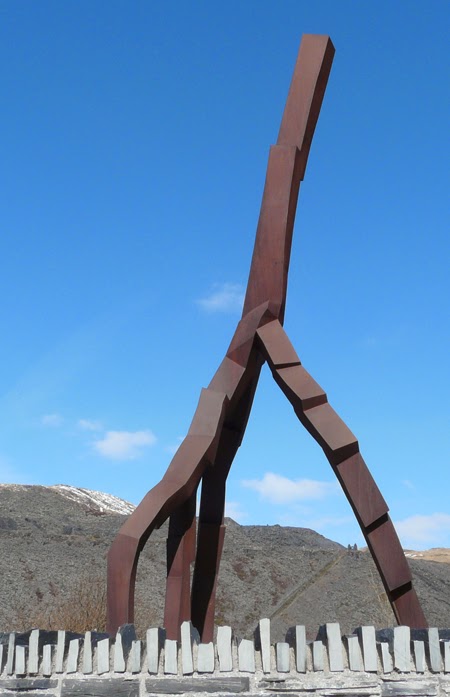
Lightning Strike by David Nash
London has the Shard and the Gherkin but we’ve got our Chisels and the Lightning Strike. This sculpture by David Nash reflects the zig-zag shape of the quarryman’s path descending the slate spoil from the Oakeley quarry. It now stands on the main road midway between the quarry and the centre of town – the only Nash work of art on permanent display in Wales.  

If words and symbols of Blaenau’s slate heritage are not enough, keep on walking about ten minutes out of town to Llechwedd Slate Caverns where you can literally get beneath the surface of it all. They offer a choice of two underground tours and provide exhibits that bring to life the incredible stories of rock cannons and wild cars. This is also the place for downhill biking; a bit like skiing, the riders buy a ‘lift pass’ for the day hurtling down a choice of runs ranging from the gentle blue to the double black. It makes a good spectator sport.

Everywhere is unique but Blaenau takes the biscuit! Local artist Falcon Hildred says in his recent book ’I believe that Blaenau Ffestiniog and its landscape are the best and most complete surviving industrial landscape in Britain’.  It’s not stuffed away in museums but all around you. Shops are one-offs where you buy bread from a baker, local meat from a butcher and discuss the finer points of DIY with the ironmonger. Cafés are homely and good value.

No amount of words can describe this place, it must be experienced. If you’ve been before, you won’t recognise it.


Sunday, 29 September 2013

Blaenau Pristine, Blaenau Ymlaen!

Twenty volunteers enjoyed a steam train ride courtesy of the Ffestiniog Railway from Porthmadog to Blaenau where they met up with members of the Blaenau Stations Support Group. Together they filled twenty bin bags full of rubbish which the council whisked away for recycling and disposal. Amongst the volunteers was a group of ten students from Glynllifon and also Gwynedd councillor Paul Thomas.

The event was organised by Cymdeithas Eryri the Snowdonia Society and designed to complement the work of the Council focusing on areas off the normal litter picking routes. It also took account of suggested hotspots from the Chamber of Commerce and Tourism. It’s amazing how much litter gets stuffed into the privet hedge around The Square or caught up in fencing around Cae Peips.

Ours was a once off litter pick but the Blaenau Stations Support Group does it every Sunday meeting at 10:15 and focusing on the station area. If you would like to lend a hand they would appreciate a few more volunteers; please contact Sally Horn on 01766 830403. 

 Blaenau is looking brilliant these days and lots of visitors are taking a look at the sculptures, the poetry and the whole town with its dramatic backdrop. Things just got even better with the reopening of the public toilets in the car park. This grade II listed building, that was once the Diffwys Railway Station, has taken on a new lease of life with great artwork linking the slate with Blaenau and its journey by train to the sea.


Blaenau Ymlaen!

Wednesday, 10 April 2013

From the Rock ... of Blaenau Ffestiniog

The streets of Blaenau are paved with slate, at least slate bands of poetry. There’s the River of Slate, a pavement mosaic with a river running through and on either bank the names of the 350 slate mines of Wales, each engraved on a block of slate the colour of that quarry. And then there are the massive slate sculptures, the 7.5 metre tall chisels, each made up of 15,000 stacked slates. They’re at a 30° angle, the lie of the Blaenau seams of slate. There is more to this town than meets the eye and recent developments cause people to stop in their tracks and wonder why?

The town is home to many relics of its industrial past and Falcon Hildred’s recent illustrated book is a great way of seeing what’s on offer. Another great way of discovery is to join the Snowdonia Society’s guided walk on Saturday 4th May led by Kevin Hall.  


The morning walk begins at 10:30 and is described as easy, about 1.5 miles mostly on pavements, to see the architecture and culture of the town, including the new O’r Graig ('From the Rock') structures and inscriptions. There will be a break for lunch, either a picnic or at a café or pub in town. In the afternoon at about 13:00 there will be a moderately strenuous walk to Pant yr Ynn, the mill where Falcon Hildred will show us his fascinating building with his collection of paintings and artefacts. If enough water is flowing the millwheel will be turning.

Later that afternoon there will be a walk of about 4 miles on more difficult terrain with some steep ground and rough terrain returning to the centre of town (by about 16:30) along footpaths via Cwm Bowydd.

The walk is open to anyone with a suggested minimum donation of £3 for members of the Snowdonia Society and £5 for non-members. Please bring a drink, a raincoat and wear appropriate clothing & sturdy footwear. All children should be accompanied by an adult.

If you would like to book onto the event please contact  info@snowdonia-society.co.uk

For those who can't make a 10:30 start there will be an alternative shorter walk led by Huw Jenkins starting at 1pm. The meeting point is underneath the canopy next to the 4 giant chisel-shaped sculptures. No need to book and donations to the Snowdonia Society will be welcome. There will be lots going on in Blaenau this weekend which is the celebration of 150 years of steam.


Sunday, 13 January 2013

Souvenirs of Blaenau Ffestiniog


Tens of thousands of people will visit Blaenau this year and I’m confident that they will be amazed at what they see.  Slate sculptures and poetry reconnecting the town centre with its industrial heritage; dramatic and stylish. But there’s even more beyond to be discovered. Apart from hiring a local guide you may like to consider two classic books.

The first is titled ‘Worktown: The Drawings of Falcon Hildred’ and provides a designer’s perspective on the various buildings around the town. Falcon states ‘I believe that Blaenau Ffestiniog and its landscape are the best and most complete surviving industrial landscape in Britain’.

Another book I would recommend is simply titled ‘Blaenau Ffestiniog’. Fantastic photos by landscape photographer Jeremy Moore and words by Gwyn Thomas, the one time national poet of Wales, whose poetry is in the sculptures, on the pavement and either side of the slate river. 

You could probably buy both books and get free supersaver delivery from an online retailer but, for the authentic experience, why not go to Siop Yr Hen Bost.  The bookshop is about a 3 minute walk from the station (south) along the main street and you’ll find lots of other treasure inside. 

Thursday, 20 December 2012

Worktown – The Drawings of Falcon Hildred

I’m biased: I like Falcon, I’ve had the pleasure of meeting him in his home, of witnessing his uncluttered way of life and hearing him describe his hopes and disappointments. I also live next to Blaenau Ffestiniog, so any comments about his book (written by Peter Wakelin) are not wholly objective.

The book contains 200 of Falcon’s drawings, now in the hands of public bodies for posterity, and the bulk of them record the industrial heritage of Blaenau Ffestiniog, Falcon’s home for over forty years. 

In the course of the book I learnt a lot about his life: how he got the impressive name of Falcon; how he came to move from Grimsby to Coventry, to London and eventually to Blaenau Ffestiniog; his bold decision to give up job security to follow his calling. I loved the drawing he sent to his mother depicting the layout of his bedsit in Putney during the times when he designed, amongst other things, first class bars and cabins for cruise liners.

Within the book there are many favourite drawings for me including the series depicting Tŷ Uncorn, the one chimney house with four tiny cottages sharing a central chimney. Was this a pioneering attempt at central heating? I like knowing what it looks like inside as I walk past it near the police station.

The final chapter is written by Falcon and titled ‘My Working Process’. On the last page he talks about the drawings made in other industrial towns in which the buildings have long since been demolished or renovated. ....’After half a century of recording, I believe that Blaenau Ffestiniog and its landscape are the best and most complete surviving industrial landscape in Britain’ .... ‘I feel we should save one example of a nineteenth-century industrial town as a complete cultural and historic entity. So my final message is: if you like my pictures, then please take care of the subject that inspired them.’  

And so we should. As for the book, not only do I recommend it, I suggest you get three copies. One for cutting out and framing images on left hand pages, another for the right hand pages and the third for a good read.

Monday, 19 November 2012

Ffestiniog on the tube map

Before
An old London underground railway carriage, built in 1892, was in use as a garden shed until recently renovated at the Ffestiniog & Welsh Highland Railway’s workshops in Porthmadog. Spick and span after 15 months TLC, and twelve coats of varnish, the carriage will undergo trials at Loughborough before returning to London. In January 2013 it / she will be pulled by Metropolitan Railway steam locomotive No. 1 on a journey through the old Metropolitan Line tunnels of Paddington, Euston, King's Cross and Farringdon to Moorgate to commemorate the 150th anniversary of the world's first underground railway.

After

Sunday, 11 November 2012

Princess dragged out of Porthmadog pub

Don’t worry, it’s not Kate Middleton on a night out with the lads, but the world’s oldest, narrow gauge steam engine. She was delivered to the Ffestiniog Railway in 1863 and was retired from service in 1946 as the last working loco when the railway ran out of steam. For some years she sat on a plinth at Blaeanu Ffestiniog, a symbol of the epic reconstruction of the line. In the last 31 years she has been in the museum and latterly the expanded bar at harbour station.

On 10th November she was dragged out of her corner, having first been jacked up and then jacked across on a pair of metal sheets lubricated with Fairy Liquid. Shifting ten tonnes of loco within the confines of a pub is no easy task – the first ten metres took about three hours. With the help of a tractor with forklift she was eventually dumped onto the railway track and towed across The Cob for a bit of restoration.

Next year she will travel by road to Paddington where she will be on display for the six weeks beginning St David’s Day (1st March). Thereafter she has several other ambassadorial appearances to make including a beer festival at Olympia in conjunction with The Purple Moose Brewery

This is how she was dragged out and her corner in the pub taken by a steam (horse drawn) fire engine.


Wednesday, 31 October 2012

River of Slate


Howard Bowcott invited me to his workshop to see the final touches to the giant jigsaw, the River of Slate. River  - because that’s how all the sediment gets washed down to create the mudstone which morphs into slate. River - because the Dwyryd was where the slate used to be boated out to the waiting ships.

This stunning work will soon be in the centre of town for people to walk on. What sacrilege! I hope they take off their shoes.

Here’s Howard busy with the slate:


Monday, 29 October 2012

Princess dragged out of Porthmadog pub


The world’s first narrow gauge steam engine Princess is to be pulled out of the pub at Porthmadog’s harbour station and taken to the workshops for a 150 year service. In the new year she will travel to Paddington where she will be on display for 6 weeks from St David’s Day. The back wall of the pub will be removed on Saturday 10th November but customers have been reassured it will be back to normal by 1pm with a replacement to look at while they drink their beer – a steam powered, horse drawn fire engine from Anglesey.

Pengwern Food, Casque Mark and Events


Lots of changes at Y Pengwern. The kitchens are now open serving great food at the weekends. Details of opening times and menus can be found on the Pengwern website. Bookings are now being taken for Christmas lunches. Groups and societies have been booking the ‘committee room’ for small meetings with refreshments. The Function Room is open for larger events and between this and the Dining Room the kitchen can cater for up to 80 people.

I always thought the bar was good but there’s now an independent hallmark of goodness – the Casque Mark was recently awarded by one of the 45 assessors who called in unannounced and sampled the various cask beers for temperature, aroma, appearance and taste. It’s one thing getting good beer from the brewery but the final step of getting it to the customers’ lips is equally important  and this is what the Casque Mark recognises. Da iawn! 

There has been a steady stream of events organised by Y Pengwern since it re-opened and one of those was last weekend’s nature walk led by Twm Elias from the pub to the Plas (Tan y Bwlch). Next events are Halloween and Fireworks. Publicising a programme of events can be a challenge but to make things easier we have installed an events listing page on the pub’s website. Organisers of events are going to be trained to use this system and pretty soon there will be a long list of things to choose from and put into your diary. Here is the events page.

Onwards and upwards. 

Wednesday, 10 October 2012

Worktown: The Drawings of Falcon Hildred

This exhibition of Falcon’s work, who lives in Blaenau Ffestiniog, opened at the Coalbrookdale Gallery, Ironbridge Gorge Museum, on 5 October 2012 and will run until 30 April 2013. It is free to enter and will be open 10am-5pm, Monday-Friday. For further details, please call 01952 433424 or visit the Ironbridge website.

Sunday, 30 September 2012

Searching for the Oldest Houses in Wales


With over 306,000 hits on the website in the last twelve months and more than a hundred members signing up since Easter the DATING OLD WELSH HOUSES GROUP is already making an impact in communities across north west Wales. “Our programme of events is very popular, with waiting lists for our guided visits to old houses and our Study Tour to St Fagans and Cosmeston Medieval village” says Margaret Dunn, Group Secretary. She has recently been made a Fellow of the Society of Antiquaries of London for her work running the successful Dating Old Welsh Houses Project and will shortly be giving a lecture on the Project to that Society in London.

Margaret added “we are excited to announce that with our partners, the Royal Commission on Ancient & Historic Monuments of Wales, we will be publishing a book titled Discovering Historic Homes in North-West Wales.

The Project spent over £250,000, including the time given by around 200 volunteers, to date, record and research around eighty Tudor houses across the region. This was only possible with grant aid from around twenty five organisations led by the HLF. Over a hundred people attended the Annual Public Lecture held this year in Conwy.

Searching for the Oldest Houses in Wales” has been selected as the topic for the Annual Lectures of both the Caernarfonshire and Merioneth county history societies.
Richard Suggett, of the RCAHMW, will be the speaker giving an emphasis on local buildings on each occasion. The Merioneth Historical & Record Society AGM & Lecture will be held on 6th October at 2.00 p.m. in Llanelltyd Village Hall, and that for the Carnarfonshire Historical Society will be held on 20th October at 2.30 p.m. in the Council Chambers, Caernarfon. All are welcome. 

Margaret commented “Another development is the newly revised bilingual website: www.datingoldwelshhouses.co.uk  which contains an increasing amount of information about the project and the Group”.   Anyone interested can join the Group via the website or contact Margaret on 01766 890550.

Friday, 21 September 2012

Festival No. 6

Bleary eyed festival goers were in good spirit on the morning of the third day. Down in The Village, the re-enactment of Checkmate, by The Six of One (Prisoner appreciation society), brought back distant memories for those of us who’d watched 1960s TV. Words like ‘groovy’ come to mind?


This was followed by Osadia, a colourful duo from Barcelona performing elaborate hair transformations to willing volunteers. 

Everyone seemed to be having a good time; posh people were staying at the hotels, others in camper vans but the majority were in tents. The mix of acts, which ranged from big name groups to folk singers, poets, artists and stand up comics, worked well – an eclectic cocktail that worked in a surreal setting.

For many people this was their first visit not only to Portmeirion but to Wales. They knew they were in Wales that Sunday evening when the Brythoniaid took to the stage and gave them a male voice choir rendition of a New Order number. This is what it sounded like in rehearsal:

Friday, 24 August 2012

Quarry Power

The weekend beginning 14th September will be a celebration of old quarry engines. Full details are on the event website including guided walks. Engines on display will include the trio of Hunslets which can be seen here pulling up a gravity train on The Ffestiniog earlier this year.  


Thursday, 23 August 2012

It's an elm!


20 to 25 million elms died of Dutch elm disease in the UK but don’t blame the Dutch, it was their scientist who identified it. Today it’s a rare sight to see an elm but you can find one on the drive down from Plas Tan y Bwlch towards The Oakeley Arms, on the right hand side, just after the turning to The Lodge.

The gardens are open to the public from 10am until 4pm and contain all sorts of trees. Oaks of course, giant limes, also the handkerchief tree and the tree of heaven. But for me the elm is the star – I wonder how it survived.

I'm told there are quite a few elms across the valley in Ceunant Llenerch.

Wednesday, 22 August 2012

Power of The Plas


It was one of the first houses in Wales to have electricity with a Gilkes turbine installed in 1905. This was used until 1928; presumably made redundant by the opening of the much larger Maentwrog hydro scheme which was big enough to power all of north Wales. Since then nuclear has been and (almost) gone and in a few months The Plas will be back to having its own hydro power generated by yet another Gilkes turbine.

Construction is fraught with conservation complication. Work on the turbine end, alongside the main road, can only be done in the summer months so as not to disturb bats. Trench work at the top end has to wait until the ecologist confirms ground nesting birds have fledged. The section through the orchard to the road has to avoid anthills. And then there are trenches beneath highly prized trees, such as the huge limes and the ‘Tree of Heaven’, which have to be hand dug to preserve the roots.

The scheme costs £420K and at current electricity prices is expected to have a ten year payback. Generating 100,000 Kw a year that’s enough for about fourteen normal households. 


Stori Traws

Stori Traws is a weekend conference, 16th to 18th November, celebrating the heritage of Trawsfynydd power station & electricity production in Eryri.

It's about the social as well as the technological impact of one of the largest industrial developments seen in North Wales during the last 50 years. It is an impressive story of innovation and engineering on a grand scale encompassing the three main phases of Trawsfynydd Power Station’s lifetime: construction, power production and decommissioning.

Footbridge, reactors and Stwlan

Now, as work on site is approaching its final stages, an imaginative programme is underway as part of the Trawsfynydd Heritage Strategy to safeguard this unique aspect of our industrial and social history by preserving documents, photographs, and the taped memories of former workers etc. for the future.

Nuclear power production though is only one part of the story of electricity generation in the area. Our conference timeline starts with the production and use of electric power in local quarries in the Victorian period, early hydro-electric schemes, establishing local supply networks, the National Grid, the advent of nuclear power, pump storage schemes and the recent revival in interest in micro-generation and concludes with a look to what the future might hold.

Interwoven with this story of technological revolution is the social and economic impact of such a large development as Trawsfynydd power station and the domestic transformation which followed the coming of power to people’s homes.

The conference begins at 7pm Friday 16th November with an open evening for the public; an exhibition of photos and a chance for former / present workers & their families to share memories. Followed by a presentation of ‘Stori Traws’ by Joanna Wright & Naomi Jones.

The weekend course costs £160 to £180 on a residential basis or £8 per session non-residential.

For further details contact Twm Elias at 01766 772600 or twm.elias@eryri-npa.gov.uk

Friday, 17 August 2012

Dragon's Back Race


200 miles and 45,000 feet of altitude starting at Conwy Castle on Monday 3rd September and finishing five days later at Carreg Cennen Castle near Llandeilo. 

 A hundred competitors from fourteen countries are expected to take part in the ultimate endurance race which was last run in 1992. Day two of the race will start with an ascent of Cnicht then Moelwyn Mawr, Moelwyn Bach, through the Vale of Ffestiniog and across the Rhinogydd. Faster runners are expected to complete each day in about eight hours whilst slower competitors will be out for over sixteen before making it to the overnight tents. The mind boggles and the price for all this ‘fun’ is a mere £500 per person.

Full details can be found at Dragon’s Back Race

Wednesday, 15 August 2012

Fat Ladies in Blaenau bus shelter


Scaffolding down and the sculptures are looking great with the steps ready to go in. Completion date only about a month away. Here’s Howard Bowcott talking about the project and some of the fine detail regarding ‘fat ladies’ in the bus shelter:


Previous films about the progress of the sculptures can be seen through these links:


Monday, 13 August 2012

Art on the line

Howard Bowcott
It’s not unusual when friends come to stay to take a walk to the pub. But with it being so hot, and someone’s ankle playing up, we chose the easy option; a down train to Tan y Bwlch then an open carriage to Blaenau. Newspapers bought we admired the new sculptures. Howard, the artist, was experimenting with finishes to bring out the colour and texture of the slate. The Queen’s Hotel, newly painted and renamed Ty Orsaf, is looking smart and recruiting staff. Someone said the downhill biking above Llechwedd was sold out for the second weekend in a row. The times they are a changing. Back on the train, coasting down to Campbell’s Platform, with a bottle of Purple Moose ... so much more than a walk to the pub.